

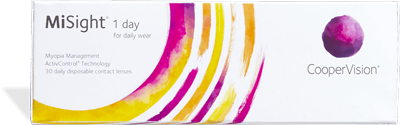
 The latest findings from CooperVision’s landmark MiSight® 1 day clinical study provides new insights about myopia management and the proven efficacy of the specially designed contact lens. Among many powerful outcomes are that nearly one-in-four children’s eyes originally fit with MiSight® 1 day remain stable for myopia after six years.1
Evaluating children who were prescribed MiSight® 1 day at the study’s initiation, 23% of eyes after year six displayed a total refractive change of less than -0.25D (spherical equivalent), which could be considered clinically stable,” says CooperVision’s Director of Research Program, Paul Chamberlain.1 “There is now even more reason to recognize the substantial capability of this unique dual-focus contact lens.”
The newest findings also suggest that while intervention at an early age is optimal with MiSight 1 day, commencing treatment at an older age could similarly slow the rate of myopia progression.1 The original control group was refit into the dual-focus lens in year four. Comparing this population to the children fit with MiSight 1 day at initiation, there have been similar rates of myopia progression and axial length growth in the subsequent three years of assessment.1
Six-year results continue to demonstrate excellent safety profile, wearing time, and visual acuity for children in daily disposable contact lenses over 653 wearing years.1 No other prospective randomized controlled study has offered conclusive data for such a high degree of continued efficacy in myopia management using a soft contact lens over a similar time span.
Myopia is projected to affect the vision and increase risks to ocular health of approximately five billion people by 2050, more than doubling today’s numbers.2 Myopic progression has been linked to sight-threatening conditions later in life such as cataracts, retinal detachment, glaucoma3 and myopic maculopathy.4
CooperVision MiSight® 1 day is the first and only soft contact lens the U.S. Food and Drug Administration has approved* for slowing the progression of myopia in children, who at initiation of treatment are 8-12 years of age.5 It is the centerpiece of the company’s Brilliant Futures™ Myopia Management Program, in which more than 1,000 U.S. ECPs are now certified. Versions of this comprehensive program are presently being introduced in other countries, including the United Kingdom, Canada, Spain and Portugal.
* Indications for use: MiSight® 1 day (omafilcon A) soft (hydrophilic) contact lenses for daily wear are indicated for the correction of myopic ametropia and for slowing the progression of myopia in children with non-diseased eyes, who at the initiation of treatment are 8-12 years of age and have a refraction of -0.75 to -4.00 diopters(spherical equivalent) with ≤ 0.75 diopters of astigmatism. The lens is to be discarded after each removal.
References
1. Chamberlain P, Logan N, Jones D, Gonzalez-Meijome J, Saw S-M, Young G. Clinical evaluation of a dual-focus myopia control 1 day soft contact lens: 6-year results (2020 American Academy of Optometry Annual Meeting).
2. Holden et al, – Global Prevalence of myopia and high myopia and temporal trends from 2000 through 2050. Ophthalmology 2016. 123(5):1036-1042.
3. What You Should Know if Your Child is Nearsighted (Infographic). Retrieved October 29, 2019 from: https://www.allaboutvision.com/parents/myopia-facts-infographic.htm.
4. Macular Society. Myopia, Pathological Myopia and Myopic Macular Degeneration. Retrieved October 29, 2019 from: https://www.macularsociety.org/sites/default/files/resource/Macular%20Society%20Factsheet%20-%20Myopic%20Macular%20Degeneration%202017%20-%20ACCESS.pdf.
5. Chamberlain P, et al. A 3-year randomized clinical trial of MiSight® lenses for myopia control. Optom Vis Sci. 2019; 96(8):556-567. Compared to a single vision 1 day lens over a 3-year period.


