

Approaching Perimenopause and Menopause Awareness Months in September and October, Johnson & Johnson, the makers of ACUVUE® contact lenses, is looking at how the impact on the eyes during this stage of life is often overlooked. Online research surveys were conducted with both female multifocal contact lens wearers and eyecare professionals (ECPs) to better understand if and how they want to talk about perimenopause and menopause—and where vision care naturally fits in.
The surveys were designed to investigate the level of interest in connecting presbyopia and feelings of dry eye and other vision changes with the broader perimenopause and menopause discussions. The answer, especially among ECPS, was clear: there is.

“Vision care is self-care, and the eyecare community has an opportunity to help women better understand that hormonal changes can affect their eyes in addition to helping correct the vision changes (presbyopia) that happen around the same time,” says Amber Gearhart, Global Strategic Marketing at Johnson & Johnson. “We wanted to understand whether this was a topic that women and ECPs were ready to talk about, and the results showed strong interest on both sides.”
Among female ECPs surveyed, 91% said they believe their female presbyopic patients would be interested in learning about their vision changes at the same time they are learning about perimenopause and menopause. This closely matches the 94% of female multifocal contact lens wearer that say they are open to this.
The research also suggests this is already showing up in practice. Two-thirds of female ECPs said their female presbyopic patients frequently express emotion over changing vision with age. More than half reported patients often mention other physical or emotional changes beyond vision. Eye dryness was most commonly mentioned, followed by headaches and explicit references to perimenopause or menopause.
WHAT PATIENTS AND ECPs ARE ALREADY SAYING

“We’re seeing that these conversations are already happening, in pieces,” says Meredith Bishop, OD, MS, FAAO, Global Medical Education at Johnson & Johnson. “Patients may come in talking about feeling eye dryness or needing readers, but they may also be experiencing other changes at the same time. This gives us a chance to help connect those dots in a simple, approachable way.”
The survey highlighted an important gap: while 76% of female ECPs believe their female presbyopic patients are dealing with presbyopia symptoms at the same time as peri/menopausal symptoms, 56% said they do not usually broaden the conversation during visits. The most common reasons were lack of time, lack of training or discomfort with the topic—reinforcing that any support in this space needs to be practical and easy to use.
“We’re not looking to create a lengthy conversation for every appointment,” Dr. Bishop says. “We want to encourage women experiencing perimenopause and menopause to get routine eye exams, and for ECPs to feel comfortable connecting the emotional benefits of clear, consistent vision.” This is an open door for ECPs to connect with their patients, as these hormonal shift symptoms and needing readers often happen around the same time.
NEEDED MESSAGE, RIGHT TIME
This research conducted by the ACUVUE® brand reinforces that point. It suggests that vision changes during this stage of life can be experienced earlier and be more emotionally heavy than expected. Readers or reading glasses, in particular, can carry a strong identity impact for many women, functioning as a visible reminder of aging that may affect self-image. With over 70% of respondents trying readers before they started wearing multifocal contact lenses, there could be an opportunity to offer multifocal contact lenses earlier than typically thought.
The findings also suggest women are open to menopause-related education about their eyes and their changing vision from both ECPs and other sources, when it is handled with care and helps them make sense of the symptoms they are already experiencing. Thoughtful, credible education does not appear to create risk of offense; instead, it can build trust and help women feel more informed as they navigate change.
Seventy-three percent of ECPs reported they have noticed an increase in media coverage around perimenopause and menopause in recent years. That combination of patient interest, provider awareness and broader cultural visibility suggests the topic is gaining momentum.
SUPPORTING ECPS AS THEY SUPPORT PATIENTS
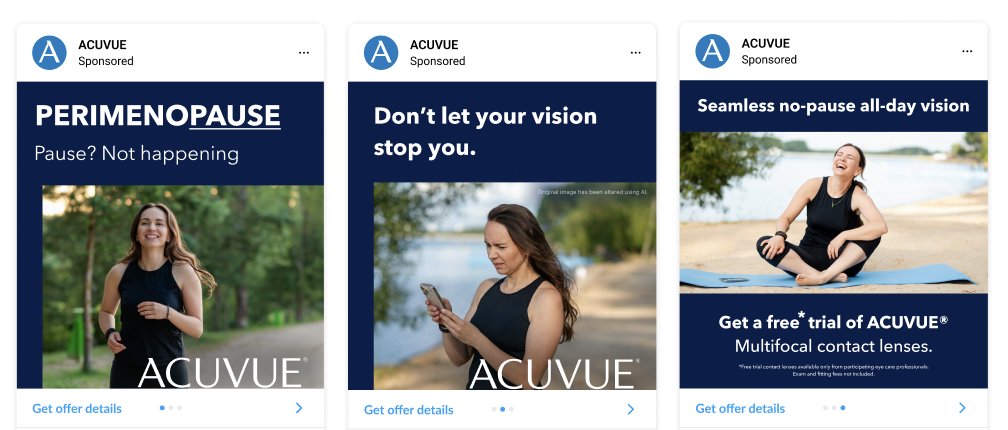
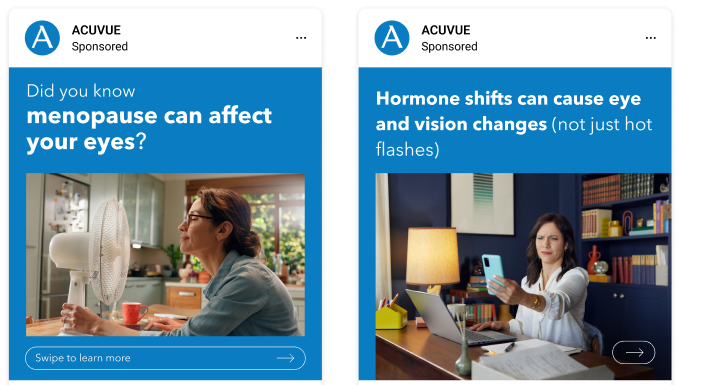
While each ECP should decide how and if they support their female patients in this manner, starting to bring awareness to the opportunity is a good step forward. ACUVUE® has created a pilot program of social and educational materials designed to start a conversation, and ease into the connection between these two previously disparate topics. The approach and tone don’t have to be overly serious, for example, one post reads, “Hot flashes? Your eyes should be a hot topic.”
The goal is that more women will include annual eye exams as part of their wellness journey during this time of life, and more ECPs will feel comfortable bringing the topic up proactively. Dr. Bishop says, “it’s important that these patients feel seen, and for ECPs to educate patients on multifocal correction options, keeping their emotional impact in mind during perimenopause and menopause.”
Are your female patients asking about menopause? Take a quick poll.
Important Safety Information: ACUVUE® Contact Lenses are indicated for vision correction. As with any contact lens, eye problems, including corneal ulcers, can develop. Some wearers may experience mild irritation, itching or discomfort. Lenses should not be prescribed if patients have any eye infection, or experience eye discomfort, excessive tearing, vision changes, redness or other eye problems. Consult the package insert for complete information. Complete information is also available from Johnson & Johnson Vision Care, Inc. by calling 1-800-843-2020, or by visiting www.jnjvisionpro.com.
All third-party trademarks herein are the intellectual property of their respective owners.
© Johnson & Johnson and its affiliates 2026
2026PP14710


